Nefertiti, Painted: A German Artist at the Egyptian Museum Berlin
Most people meet Nefertiti through glass. The painted limestone bust in Berlin is one of the most photographed faces in the world, and almost every picture of it is the same picture: the long neck, the flat crown, the one missing eye. In 1993 the museum that keeps her let a living painter answer that picture with his own.
Six years on one face
Peter Wirth (1951–2018) was a painter from the Ruhr, trained at the Folkwang school in Essen. Between 1987 and 1993 he painted the Egyptian cycle: some sixty canvases, acrylic on unprimed cotton, worked over and scraped back until the famous profile is barely a profile any more. Nefertiti was where it began; the cycle soon brought the old gods into his studio too – Thoth, Anubis, Horus, Sobek, Bastet, Apis and Khnum. He never set out to copy any of them. “The stylistic perfection of ancient Egyptian art drew me in,” he said in Berlin.
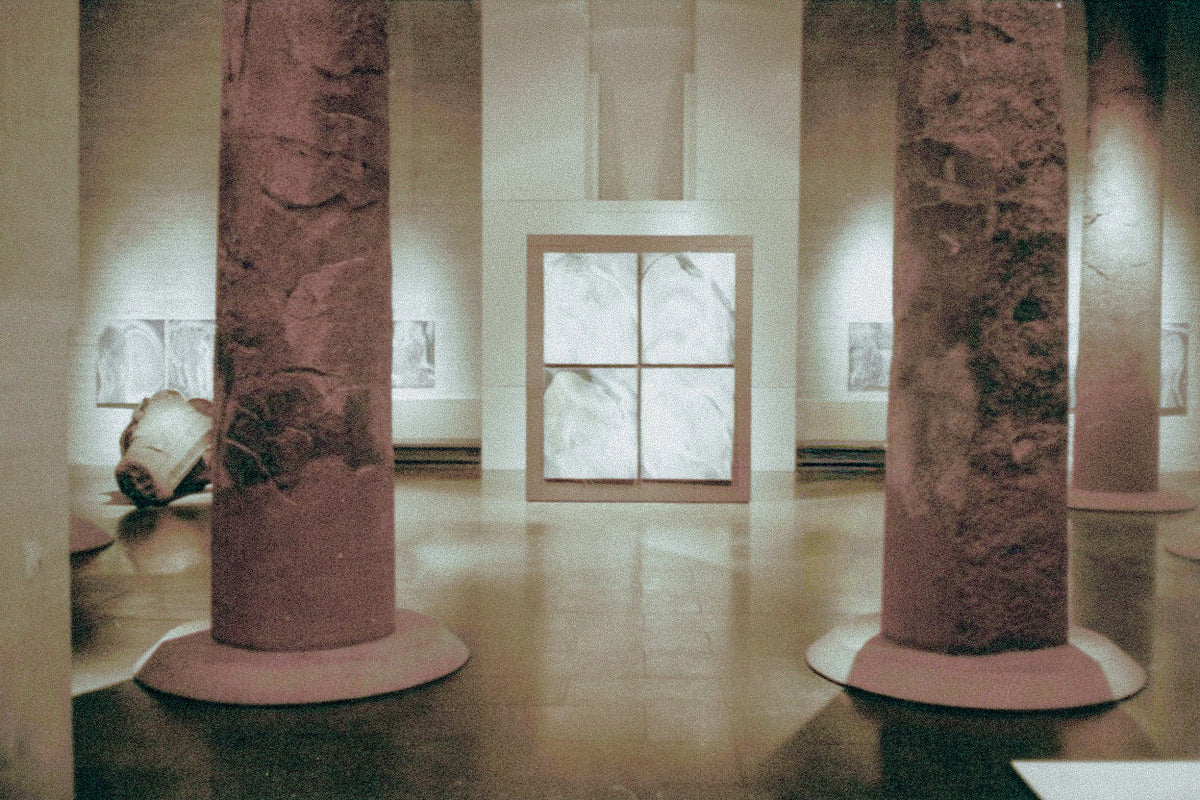
The Egyptian Museum gave the cycle a solo exhibition, Mutmaßungen über Nofretete – Conjectures on Nefertiti. Twenty-nine works hung on the ground floor, below the bust itself. The catalogue text was written by Prof. Dr. Dietrich Wildung, who directed the collection from 1989 to 2009.
What Berlin wrote
“It is the attempt of a kindred spirit to come closer.”
Renate Franke, Berliner Zeitung, 1993 · See the clipping
“A dialogue between antiquity and the modern, provocative and stimulating.”
Berliner Kurier, 1 August 1993 · See the clipping
Translated from the German by Divine Editions.
Twelve years later, in linocut
In 2004 and 2005 he came back to the same head in a harder material: a series of linocuts, Nefertiti and Chephren beside her, flat colour and sharp edges. Where the paintings dissolve the face, the linocuts cut it back to a few lines. Same question, opposite answer.
Bringing her home
Eighteen sheets from the cycle are available as archival prints on Hahnemühle® German Etching® – ten after the paintings, eight after the linocuts. Wirth photographed these works in the two-megapixel years, so the prints come in small, intimate formats, from 5 × 7 to 11 × 14 inches. On a desk, beside a bookshelf or in a hallway, a small Nefertiti does what the large one in Berlin does: it makes you stop and look twice.
Each sheet is printed to order, carries a registration number from the estate archive and ships with a certificate. Two or three together make a quiet small wall: Thoth beside Anubis, or Horus between two linocuts.