

Egypt, 1992–2005
In 1993 the Egyptian Museum in Berlin showed Peter Wirth's Nefertiti cycle under the title Mutmaßungen über Nofretete — Conjectures on Nefertiti. The catalogue text was written by Dietrich Wildung, then director of the museum (Dietrich Wildung / Peter Wirth, Mutmaßungen über Nofretete, published by the Verein zur Förderung des Ägyptischen Museums Berlin e.V., Berlin 1993). Two passages from that text stand on the artist's page.
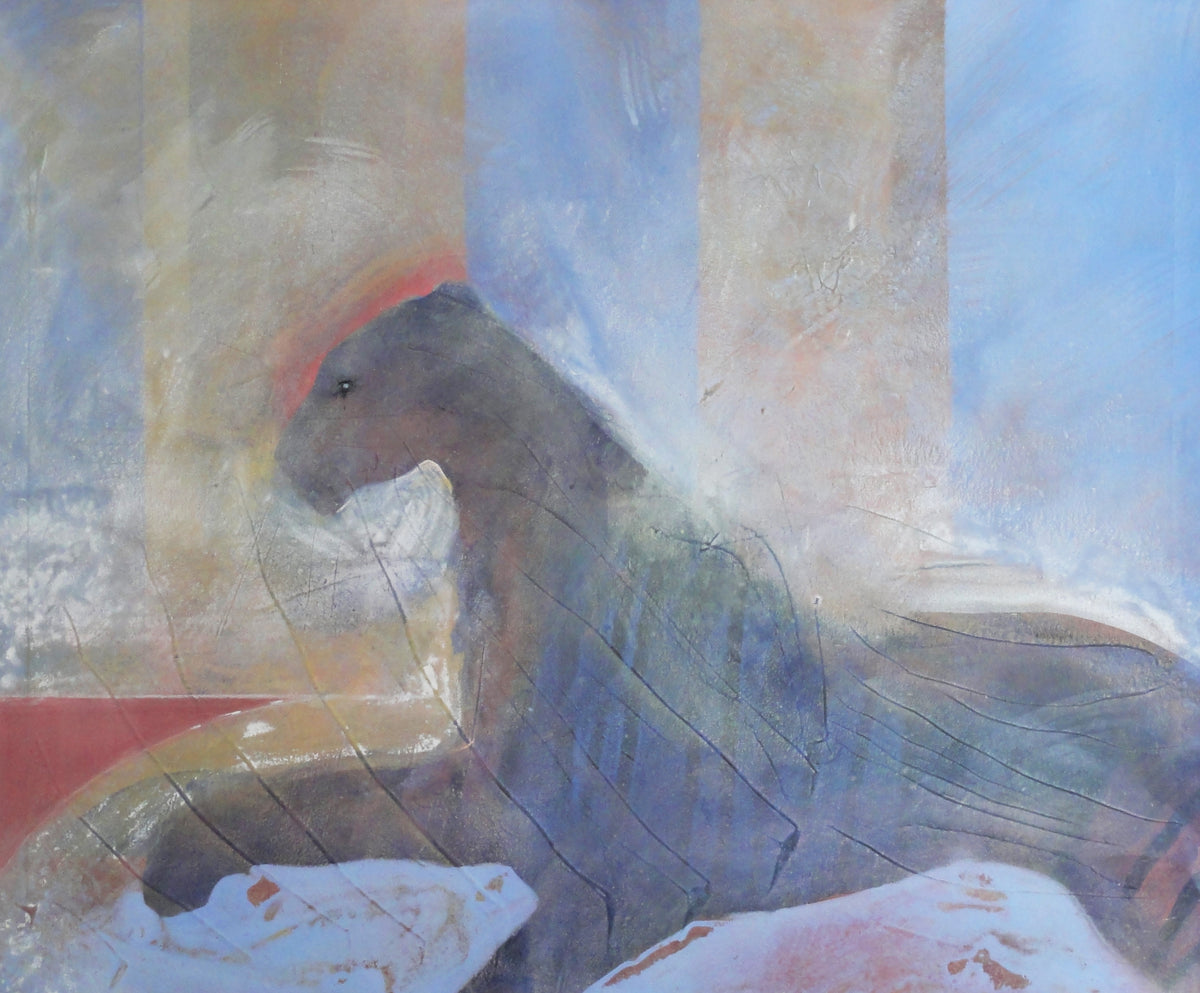
Two techniques, and two motifs. The eight linocuts of 2004/05 show the queen herself: the same flat, backward-sloping crown profile in eight color settings, and in two of them her name is cut into the block. The ten paintings — acrylic on unprimed cotton canvas, 1992 and 1993 — show something else. Long-jawed and beaked heads on arched necks: guardian and bird figures, painted in the years that led to the Berlin exhibition and shown in it.
Read more
Nefertiti was Great Royal Wife of Akhenaten — a queen, not a goddess of the Egyptian pantheon. Every head can be named: Sobek with the crocodile head, Thoth three times with the head of an ibis, and Khnum with the ram's head, shown in 1993 as Widderköpfiger. Anubis twice, Horus, Bastet and Apis we read from the heads; the painter left these without a name.
Everything here is an open-edition pigment print after the original. The eight linocut sheets are prints after original linocuts — they are not linocuts, and each product page says so plainly. Prints are not numbered and not capped, and the signature on each sheet is printed, not applied by hand.
Seven gallery walls are drawn from this group: three, six or all eight color settings of the cut profile, and three, six, nine or all ten of the paintings, hung so the ground opens from shadow into color. Each size is contained in the next, so a wall can be grown without buying anything twice. A set of three or more costs less than the same sheets bought singly, ships as one parcel, and every sheet in it carries its own certificate.
The archive photographs set the limit: single sheets come in 5 × 7 to 11 × 14 inches, some also in 12 × 16; the sets come in 8 × 10 inches. Each size follows the archive photograph — no AI is involved.
Not sure what fits? Find your work in five questions